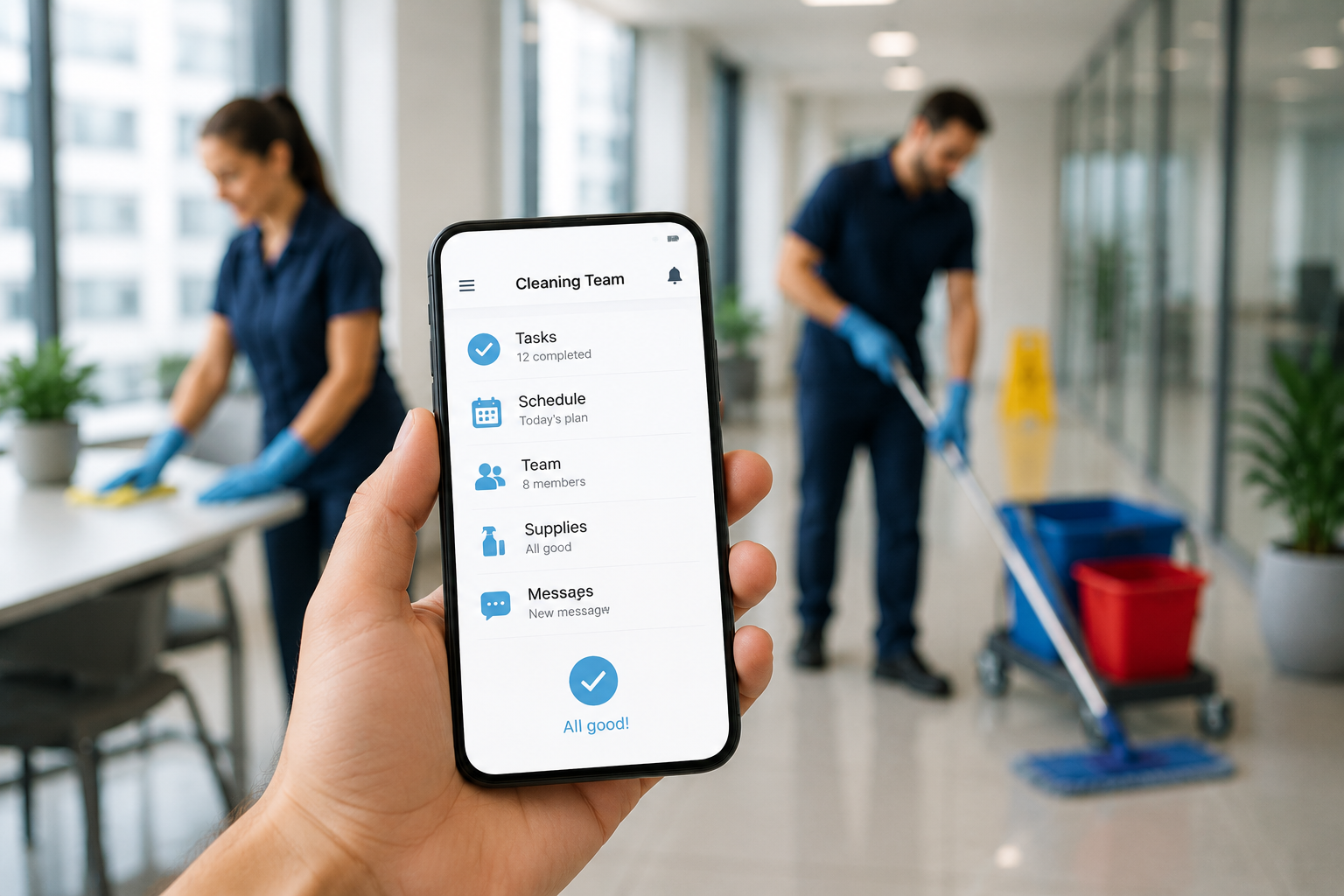
The real problem with coordinating a cleaning team
If you run a cleaning company with five, eight or twelve workers, your day probably starts before eight with the first WhatsApp message and ends with you replying to the last one at nine in the evening. That's not managing: that's firefighting.
Coordinating cleaning teams comes with a specific challenge that almost no other sector faces: your workers are spread across the entire city, in different flats, offices and premises, with no way for you to see them or know exactly what's happening at each location.
The result is predictable: constant calls to confirm a job has finished, messages lost between WhatsApp groups, incidents that nobody reported until the end of the day. And you, at the centre of it all, with no real visibility.
Why Excel and WhatsApp aren't enough
There's nothing wrong with starting out with Excel and WhatsApp. Most cleaning companies do, and it works up to a point. The problem is that they don't scale.
When you have three workers, you can keep track of everything in your head. When you have eight, you need proper tools. And when you reach twelve or fifteen, the whole system falls apart.
These are the most common signs that your coordination has reached its limit:
- You waste time every morning reorganising the schedule because something has changed.
- You don't know whether a job has been completed until you ring the worker directly.
- Incidents reach you late, when there's already nothing you can do.
- You're wary of taking on another worker because you already can't keep on top of everything.
- Important information is scattered across messages, notes and your own memory.
If you recognise yourself in two or more of these points, the problem isn't your management ability. It's that the tools you're using weren't designed for this.
What good cleaning team coordination actually looks like
Good coordination doesn't mean knowing where every worker is at every moment or monitoring every step they take. It means having the right information at exactly the right time to make quick decisions.
In practice, that comes down to three concrete things:
1. Knowing which jobs are under way and which have already finished
Without having to ring anyone. If a worker checks in when they arrive and checks out when they leave, you can see the status of every job that day in real time. If something hasn't been closed off by the expected time, you receive an alert. Simple as that.
2. Receiving incident reports the moment they happen
An access point that isn't working, a breakdown, a client complaint. If the worker can report it from their mobile with a photo on the spot, you can act immediately — not at six in the evening when it's already too late to do anything.
3. Assigning jobs without wasting time
Every time you change something in the schedule, you need to let the worker know. If that happens within a platform, the assignment goes straight to their mobile. No forwarding, no confusion, no "I didn't see the message".
How to move towards more efficient coordination
You don't need a sweeping digital transformation overnight. The most practical approach is to start with the biggest pain point. For most cleaning team coordinators, that point is always the same: not knowing whether the day's jobs are being completed.
Once you have visibility over that, everything else becomes more manageable. You can plan the week more effectively, handle last-minute changes more calmly, and above all, stop being permanently tethered to your phone.
Platforms like Klani are designed specifically for this: so that the coordinator or owner of a cleaning company has full control without needing to ring every worker or live inside WhatsApp. With a visual calendar, GPS check-in from the worker's app, and automatic alerts when a job isn't closed on time, coordination stops being a constant source of stress.
And the best part: you don't need to be a tech expert to start using it from day one.
Conclusion: better coordination is possible — and it's not that complicated
Operational chaos in a cleaning company isn't inevitable. In most cases, it's the result of using tools that stopped being fit for purpose a long time ago.
Moving towards more organised coordination doesn't mean losing control or overcomplicating what already works. It means winning back time, reducing calls, and having the peace of mind of knowing that what's been planned is actually being carried out.
If you'd like to see how it works in practice, try Klani for free and see for yourself what changes in your company when you stop coordinating over WhatsApp.